- In the diagram
is a circle with centre and . Find . 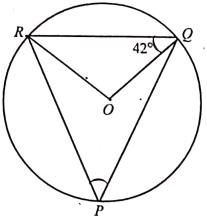
A.
B.
C.
D.
Answer: D.
Explanation:: In, (radii), so the triangle is isosceles. Thus, . .
The angle at the circumference is half the angle at the center:.
2. In the diagram,is similar to . and . Find . 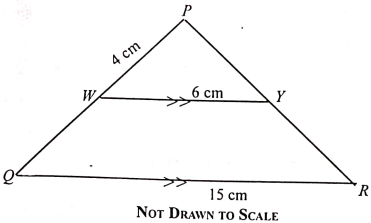
A.
B.
C.
D.
Answer: D.
Explanation:: In similar triangles, the ratio of corresponding sides is equal:.
In the diagramis tangent to the circle at . The centre of the circle is and . Use the information to answer the next two (2) questions. 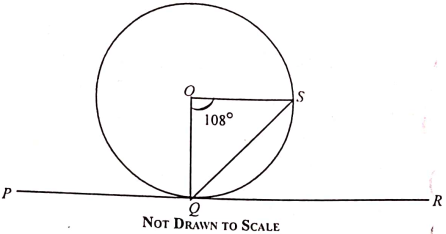
3. Find.
A.
B.
C.
D.
Answer: C.
Explanation:: In, (radii). Thus, it is an isosceles triangle and . .
4. In the diagram,is a diameter of the circle with centre . Find the value of . 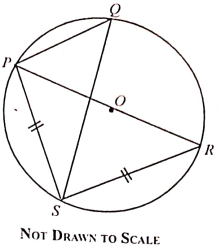
A.
B.
C.
D.
Answer: D.
Explanation:: Sinceis a diameter, . If and symmetry is implied (or is a specific cyclic quad), is a right isosceles triangle, making .
The table describes the relation, where and are constants. Study the table carefully and use the information to answer the next two (2) questions. 1 2 3 4 0 2 4 6
5. Ifis reflected in the line , find the coordinates of the image of .
A.
B.
C.
D.
Answer: C.
Explanation:: Reflectingin : the -distance from to is units. The image will be units on the other side of : . Coordinates .
6. What is the gradient of the equation of the line?
A. 2
B. 1
C.
D.
Answer: D.
Explanation:: The gradient () is calculated using .
Using pointsand : .
7. Find the equation of the line described in the table.
A.
B.
C.
D.
Answer: B.
Explanation:: Using the gradientand -intercept (from point ):
Multiply by 2:.
8. The volume of a cone is. If the base radius is , find the height.
A.
B.
C.
D.
Answer: A.
Explanation:: The volume of a cone is.
9. Find the value offor which is not defined.
A.
B.
C.
D.
Answer: B.
Explanation:: An algebraic fraction is not defined when the denominator is equal to zero.
10. The range of a sample of 10 numbers is 5 and the largest value is 50. What is the least value?
A. 60
B. 55
C. 40
D. 45
Answer: D. 45
Explanation:: The range is the difference between the largest and smallest values:.
11. The second term of a Geometric Progression (G.P) is 9. If the fourth term is 81, find the common ratio.
A. 4
B. 1
C. 2
D. 3
Answer: D. 3
Explanation:: For a G.P,. and .
Divideby : . .
12. A cylindrical container closed at both ends has a radius ofand height . What is the total surface area of the container?
A.
B.
C.
D.
Answer: C.
Explanation:: The total surface area of a closed cylinder is. .
13. The diameter of a bicycle wheel is. If the wheel makes 8 complete revolutions, what will be total distance covered by the wheel?
A.
B.
C.
D.
Answer: C.
Explanation:: One revolution equals the circumference:.
Total distance.
14. The interior angles of a triangle areand . Which of the following accurately describes the triangle?
A. isosceles triangle
B. right-angled triangle
C. equilateral triangle
D. scalene triangle
Answer: C. equilateral triangle
Explanation:: The sum of angles in a triangle is: .
The angles are:.
Since all angles are, it is an equilateral triangle.
15. Ifand , find the set .
A.
B.
C.
D.
Answer: C.
Explanation:: The intersectionconsists of elements that are present in both sets and . Comparing the two sets, the common elements are and .
16. An office equipment depreciates atper annum. If the cost is when new, find the value after three years.
A.
B.
C.
D.
Answer: C.
Explanation:: Depreciation is calculated using the formula.
17. Solve:.
A.
B.
C.
D.
Answer: B.
Explanation:: Multiply the entire equation by the LCD, 12:
18. Given that, find the value of .
A. 2
B. 5
C. 4
D. 3
Answer: B. 5
Explanation:: In modular arithmetic,typically refers to the remainder of . .
The remainder is.
19. Given that, find the value of .
A.
B.
C.
D.
Answer: C.
Explanation:: If, then opposite and hypotenuse . Adjacent . and . .
20. Mr. Abban investedfor 3 years at per annum compound interest. Find the interest earned at the end of three years.
A.
B.
C.
D.
Answer: A.
Explanation:: Total Amount.
Interest.
21. Find the value ofthat satisfies the equation: .
A. 1
B. 4
C. 3
D. 2
Answer: A. 1
Explanation:: Multiply the entire equation by the LCD, 6:.
22. Mr. Amuzu sold his car through an agent who chargedcommission on the selling price. If Amuzu received after the sale, find the selling price of the car.
A.
B.
C.
D.
Answer: A.
Explanation:: If the agent’s commission is, Amuzu received of the selling price.
Let the selling price be: .
In an examination taken by 120 students, 90 passed Mathematics, 40 passed Science and 5 failed both subjects. Use the information to answer the next two (2) questions.
23. How many students passed Science only?
A. 15
B. 75
C. 25
D. 20
Answer: C. 25
Explanation:: Letbe the number of students who passed both. Total . .
Science only.
24. Find the probability that a student selected at random passed only one subject.
A.
B.
C.
D.
Answer: B.
Explanation:: From the Venn diagram: passed Mathematics only, passed Science only .
Total only one subject.
Probability.
25. If the variableis inversely proportional to and when , find when .
A. 7.5
B. 8.5
C. 9.0
D. 9.5
Answer: C. 9.0
Explanation:: Since, we have .
Substituteand to find : .
Now, findwhen :
26. Find the product ofand .
A.
B.
C.
D.
Answer: B.
Explanation:: Convert to base 10:. .
Product.
Convertto base 7: rem 5; rem 1; rem 2; rem 3.
Result.
27. Ifis negative and is negative, in which quadrant would lie?
A. First
B. Fourth
C. Third
D. Second
Answer: C. Third
Explanation:: In the first quadrant, all ratios are positive. In the second, only sine is positive. In the third quadrant, both sine and cosine are negative (only tangent is positive). In the fourth, only cosine is positive.
28. The mean of ten numbers is 16. When another number,, is added, the mean becomes 18. Find the value of .
A. 38
B. 32
C. 34
D. 36
Answer: A. 38
Explanation:: The sum of the original ten numbers is.
With the eleventh numberadded, the new sum is .
29. Makethe subject of the relation .
A.
B.
C.
D.
Answer: A.
Explanation:: Square both sides:.
Factor out: .
Find a common denominator:.
Solve for:
30. Seven men complete a certain work schedule in 6 days. How long will it take two of the men to complete the same work schedule if they work at the same rate?
A. 42 days
B. 35 days
C. 21 days
D. 14 days
Answer: C. 21 days
Explanation:: This is an inverse proportion. The total work isman-days.
If two men do the work, the time taken is:
WASSCE General Mathematics 2024 (Paper 1)
By Lawrence Ephrim • November 01, 2026